


Cookies help us deliver our services. By using our services, you agree to our use of cookies.
MIL-STD-1553 Tutorial
1. Introduction and History
1.1 What is MIL-STD-1553?
MIL STD 1553 is the most widely used avionics data bus standard in modern military aircraft, missiles, and space systems. This guide explains the protocol, electrical design rules, message formats, and how Holt ICs simplify 1553 integration. Officially titled the "Digital Time Division Command/Response Multiplex Data Bus," MIL-STD-1553 was designed to provide a reliable method for integrating avionics subsystems.
The standard defines a Command/Response protocol, meaning that all communication on the bus is centrally controlled and deterministic. No device speaks unless spoken to. This architecture ensures high data integrity and predictable timing, which are critical for flight controls, weapons systems, and mission-critical avionics.
Key characteristics of the bus include:
- Data Rate: 1 Megabit per second (Mbps).
- Physical Layer: Dual-redundant, bi-directional, shielded twisted pair transmission line.
- Encoding: Manchester II bi-phase encoding for high noise immunity.
- Architecture: Supports up to 31 Remote Terminals (RTs) controlled by a single Bus Controller (BC).
1.2 The Evolution of the Standard
Before the adoption of a multiplexed data bus, avionics systems relied on complex point-to-point wiring. Each new sensor or radio added to the aircraft required dedicated wires to every other device it needed to talk to. As aircraft systems became more sophisticated, this wiring became bulky, heavy, and expensive to modify/retrofit.
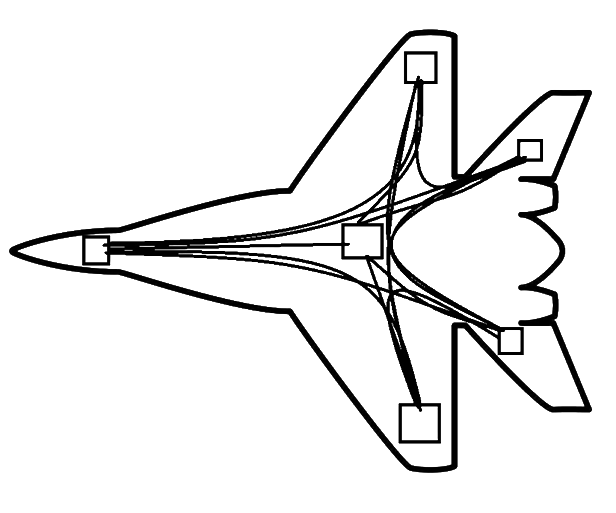
Figure 1 - Point-to-Point Wiring Scheme
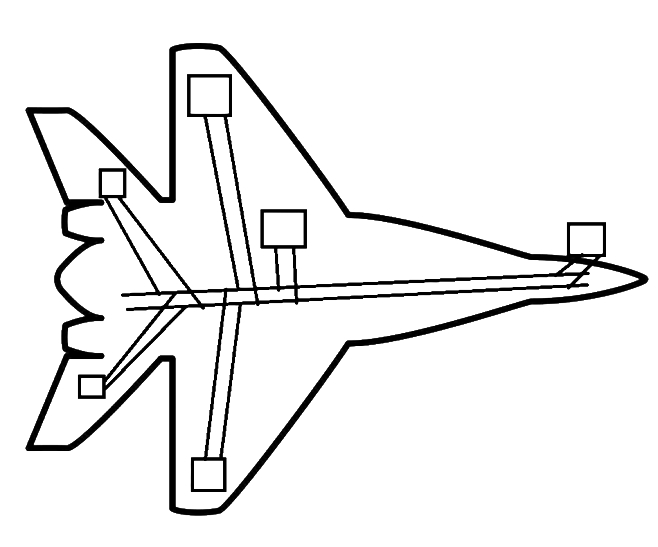
Figure 2 - Multi-drop Data Bus
The MIL-STD-1553 standard was developed to solve this "integration complexity" problem by allowing all devices to share a single twisted-pair cable. Comparing Figure 1 and Figure 2 illustrates the significant reduction in wiring complexity when moving from discrete connections to the MIL-STD-1553 shared bus topology.
- 1968-1973: The initial concepts were drafted by the Society of Automotive Engineers (SAE) in 1968, leading to the US Air Force’s adoption of MIL-STD-1553 in 1973.
- MIL-STD-1553A (1975): The first tri-service version was released and used on platforms such as the F-16 and the AH-64A Apache Attack Helicopter.
- MIL-STD-1553B (1978): The standard was refined to improve interoperability. This version, still in use today, defines the strict electrical and protocol specifications that modern Integrated Circuits must meet.
The standard has been updated via "Notices" to accommodate evolving requirements without altering the core specification:
- Notice 2 (1986): This was a significant update that superseded Notice 1. It established a true tri-service standard (Army, Navy, Air Force) and tightened requirements for RT design.
- Notices 3 & 4: Released in 1993 and 1996 respectively, these were primarily administrative title changes and did not alter the technical content.
1.3 Modern Applications and Relevance
Despite being designed in the 1970s, MIL-STD-1553B remains the internationally accepted networking standard for military platforms. Its extremely low error rate (1 word fault per 10 million words) and dual-redundant architecture make it ubiquitous in mission-critical environments.
Today, the standard is found across a wide spectrum of aerospace, defense, and industrial platforms, including:
- Aircraft:
- Fighters: F-15, F-16, F-18, F-22, F-35.
- Transports: C-130, KC-135.
- Commercial: Airbus A350 XWB.
- UAVs: Predator, Global Hawk, Hunter, Others.
- Rotary: Apache.
- Space:
- ISS, Satellites, Launchers.
- Weapons (MIL-STD-1760):
- Missiles, Launchers, Pylons, Smart bombs, Bomb Racks.
- Ground Support:
- Ground Stations, test equipment.
- Industrial:
- Down Hole Drilling.
1.4 Holt Integrated Circuits: Modernizing the Interface
While the standard has remained consistent, the hardware implementation has evolved dramatically. Early implementations required large, discrete boards to handle the protocol and electrical drive requirements.
Holt Integrated Circuits has revolutionized this landscape by miniaturizing the MIL-STD-1553 interface. By providing single-chip solutions that integrate the protocol logic, shared RAM, transceivers, and even the isolation transformers (such as the HI-2130), Holt enables designers to implement this robust standard with minimal board space and maximum reliability.
This tutorial acts as a comprehensive guide to understanding the standard, from the physical waveforms to the message protocols, while highlighting how modern ICs simplify the design process.
Chapter 2.
Explore
- Chapter 2. The 1553 Bus Architecture
- Chapter 3. Electrical Characteristics (The Physical Layer)
- Chapter 4. Protocol & Message Formats
- Chapter 5. Mode Codes & Bus Management
- Chapter 6. MIL-STD-1760: The Weapons Store Interface
- Chapter 7. Testing & Integration
- Appendix A: MIL-STD-1553 Evolution and Revisions
- Appendix B: Acronyms and Abbreviations
- Appendix C: Applicable Documents
- MIL-STD-1553 FAQ