


Cookies help us deliver our services. By using our services, you agree to our use of cookies.
Discrete-to-Digital / Drivers
What does a discrete-to-digital device do?
Discrete‑to‑Digital devices convert analog binary signals into digital outputs that can be processed by electronic systems. Common examples include switches and sensors in avionics and industrial equipment.
Devices offer GND/Open, Supply/Open (28 V/Open), or dual‑mode sensing, integrated protection, and flexible interfaces for robust state detection in noisy or safety‑critical systems.
GND/Open vs. Supply/Open – What’s the difference?
GND/Open detects whether a switch is tied to ground or floating, while Supply/Open detects whether a switch is tied to a voltage supply (e.g., 28V) or floating.
How does GND/Open sensing work?
For GND/Open sensing, if an analog sense input is “Open”, the corresponding digital output will be logic 0. Conversely, if an analog sense input is at “Ground” potential, then the corresponding digital output will be logic 1. Below is an example using Holt's HI-84220.
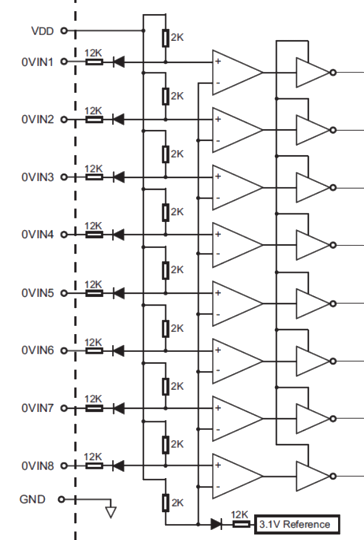
Figure 1. GND/Open Inputs of HI-84220
An internal comparator compares the discrete input voltage on its non-inverting input to the internal reference voltage on its inverting input.
If the discrete input is left open, then the non-inverting input of the comparator gets pulled up to 5V by the internal resistors. This is higher than the internal reference voltage on the inverting input, so the output of the comparator will be a logic 1. This then goes to an inverter, which flips it to a 0.
If the discrete input is grounded, then the non-inverting input of the comparator will be lower than the reference voltage on the inverting input, so the output of the comparator will be a logic 0. This then goes to an inverter, which flips it to a 1.
Thus, for GND/Open discrete inputs, an open input will give a low output, and a grounded input will give a high output.
Similar logic applies to GND/Open inputs on other Holt discrete-to-digital devices.
How does Supply/Open sensing work?
For Supply/Open sensing, if an analog sense input is “Open”, the corresponding digital output will be logic 1. Conversely, if an analog sense input is at “Supply” potential (e.g., 28V), then the corresponding digital output will be logic 0.
Below is an example using HI-84220.
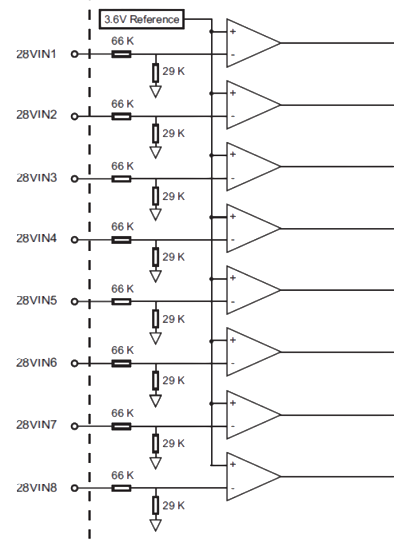
Figure 2. Supply/Open Inputs of HI-84220
An internal comparator compares the discrete input voltage on its inverting input to the internal reference voltage on its non-inverting input.
If the discrete input is left open, then the inverting input of the comparator gets pulled down by the internal 29k resistor. The internal reference voltage on the non-inverting input of the internal comparator is then higher than the inverting input of the comparator, so the output of the comparator will be a logic 1.
If the discrete input is connected to a supply (28V), then the resistor divider presents ~8.5V on the inverting input of the comparator. The internal reference voltage on the non-inverting input of the internal comparator is then lower than the inverting input of the comparator, so the output of the comparator will be a logic 0.
Thus, for Supply/Open discrete inputs, an open input will give a high output, and a supply (28V) input will give a low output.
Similar logic applies to GND/Open inputs on other Holt discrete-to-digital devices.
What applications are best for GND/Open sensing and Supply/Open sensing?
GND/Open sensing is ideal for systems where many switches reference ground. Supply/Open is used in avionics where 28V logic levels and high noise immunity are required.
Discrete-to-Digital Device Selection Guide
- Ground-sense only: HI-8427, HI-84200, HI-84230, HI-84201, HI-84231.
- Supply-sense only: HI-84210, HI-84240
- Dual-mode sensing: HI-8428, HI-8429, HI-8435, HI-8436, and HI-8437 for a SPI interface, or the HI-84220 for a parallel interface.
- High-density sensing: HI-8435 ,HI-8436, HI-8437 have 4 banks of 8 channels each for a total of 32 inputs.
- To achieve more than 32 inputs, multiple devices may be daisy-chained together to allow a single SPI sequence to program configuration or capture data from the devices in one operation
- With galvanic isolation: The HI-8400 and HI-8427 provide galvanic isolation between the sensor inputs and the logic interface. The HI-8400 can be configured for both GND/Open and Supply/Open, while the HI-8427 can only be configured for GND/Open.
- Please refer to the “Discrete-To-Digital Selector Guide” on the website for a comparison of these devices.
I am designing a complete discrete I/O subsystem. Does Holt have any devices that can also drive relays, lamps, or other loads in addition to sensing inputs?
Yes, Holt offers a diverse portfolio of discrete-to-digital devices ICs with integrated output drivers. The HI-8425, HI-8430, HI-8426, and HI-8431 each have 8 sense inputs that can be programmed as either GND/Open or Supply/Open, and 4 integrated output drivers.
The HI-8425 and HI-8426 output drivers are low-side, while the HI-8430 and HI-8431 output drivers are high-side.
I would like to transmit the status of the discrete lines in my application over an ARINC 429 bus. Does Holt have any devices that can do this?
Yes, the HI-8470 can be used to transmit the status of up to 16 discrete inputs in ARINC 429 format. This device also includes an integrated line driver for direct connection to an ARINC 429 bus.
Does Holt have any devices with built-in debouncing?
The HI-8429 features an optional debounce circuit that can be enabled to ensure sensor outputs respond correctly to mechanical inputs. The debouncing filters out mechanical switch “chatter” or noise before the signal reaches the system MCU.
What is the recommended decoupling capacitor scheme for each of the Discrete-to-Digital power supply inputs (VWET, VLOGIC, VDRV)?
Reviewing the ADK documentation can provide useful information on appropriate decoupling choices. Holt recommends a 10uF, 50V multilayer ceramic capacitor and a 0.1uF, 50V capacitor at each of the Vwet and Vdrv pins. Lower voltage rated capacitors may be used on the Vlogic pins (i.e., 10uF, 10V and 0.1uF, 10V ceramic capacitors).
Decoupling capacitors should be placed as close as possible to the source for the signal being decoupled. I.e., the pin for the device. Vias to the power plane and ground plane should be placed immediately adjacent to the capacitor. Using two vias rather than one for each capacitor pad will help reduce loop inductance and improve decoupling performance.